
Should you put off your divorce until after exam season?


Waiting until after your children’s exams to start your divorce might feel like the right thing to do. But it rarely makes things easier – for you or your children. Conflict and uncertainty at home are often harder on children than the news itself.
Exam season has a way of putting everything on hold. You tell yourself: once the GCSEs are done, or once the A-levels are over, then we'll break the news and sort out the divorce. It feels like the responsible thing to do: protect the kids from any extra stress that could impact their results.
But waiting might actually be making things harder, both for you and for your children.
If you're separating and your children are heading into GCSEs, AS-levels or A-levels, this one's for you.
Read on to learn more about navigating separation during exam season, or watch our video on how to talk to your children about divorce:
Why the waiting game isn't as protective as it feels
It's completely natural to want to shield your children during a high-pressure time like exam season. But your children are perceptive. They pick up on tension, on whispered conversations or on the general atmosphere at home.
Getting started with your separation now isn't creating chaos, it's beginning to clear it. It's giving yourself a plan, a direction and the mental space to be the present, focused parent your child needs right now.
Uncertainty is often more difficult to deal with than sad news.
And research shows that it’s not divorce itself that affects children the most, it’s conflict.
It's also worth knowing that a divorce in England and Wales takes a minimum of 26 weeks from application to final order – and reaching a financial agreement takes additional time on top of that. With GCSEs running until 26 June and A-levels until 23 June, if you start now, the legal process could be well underway before results day. Waiting until after exams doesn't make the process any shorter – it just delays when your family gets to the other side.
Tips for navigating separation when your child has exams
1. Look after yourself
If you're exhausted, overwhelmed or emotionally running on fumes, it will be harder to support your child through their exams, no matter how hard you try.
So be intentional about your own support. Lean on trusted friends. Consider speaking to a therapist or counsellor. Give yourself permission to process what you're going through. Read more about self-care during divorce.
At amicable, our Divorce Specialists are trained to support you through the emotional parts, as well as the practical side of separation. You don't have to figure this out alone.
2. Starting your separation now frees up your headspace
It might feel counterintuitive, but putting off the legal and financial side of your separation doesn't remove it from your mind. It just leaves it there, unresolved, quietly draining your energy.
Taking the first steps now, even small ones, means you're building momentum. You're moving from 'this is all still ahead of us' to 'we're dealing with this, together, in a manageable way.'
Think of it this way: the legal process can run quietly in the background while your family focuses on exams. You don't have to have difficult conversations every day. You just have to start.
The earlier you start on a cooperative, constructive path, the better the foundations you're building. The goal isn't to have everything resolved by results day. It's to have made a start - so that instead of carrying the weight of an unresolved decision, you can show up for your child during one of the most important periods of their school life.
3. Don't let perfect timing become a reason to stall
There will always be a reason to wait: exams, the summer holidays, a birthday, Christmas. But the 'right time' to start a separation rarely arrives on its own – and the longer things stay unresolved, the longer everyone in the family lives with the uncertainty.
If you're finding it hard to take the first step, it can help to break it down. You don't have to have everything figured out all at once – small steps still move things forward. That might look like:
- Booking a free 15-minute advice consultation to understand your options
- Exploring our divorce timeline tool to understand what the process looks like from start to finish
- Having an initial conversation with your ex-partner about how you'd both like the process to look
- Writing down a rough list of your finances, assets and debts so you have a clearer picture
One small step is enough to start.
4. Watch how much time you’re spending online
Separation can pull you towards some dark corners of the internet. Divorce forums full of horror stories. Social media accounts that stoke fear, guilt or anger. Communities where people compete over who's been treated worse.
It's human to seek out others going through the same thing. But not all support is equal. Some of it will leave you feeling worse, more anxious and more adversarial. And that's the opposite of what you and your children need right now.
Seek out voices that are constructive and realistic. Follow accounts that talk about cooperative separation, healthy co-parenting and moving forward. The content you consume shapes how you think about what's possible.
We built our own community platform amicable space, for this exact reason.
You can also listen to The Divorce Podcast, which explores separation from different angles and offers supportive content and real stories to guide you through separation.
5. Your children don’t need all the details
Your children don't need to know the exact details of your separation: the finances, the disagreements, the legal process. They just need to know they're loved, that both parents are there for them, and that whatever is happening at home, their exams and their futures still matter enormously to you both.
Where possible, have the hard conversations out of earshot, at a time that isn't right before a revision session or an exam. And if your child does come to you with worries or questions, answer honestly but simply. Reassurance goes a long way.
6. Talk to their school
You don't need to go into detail, but it's worth letting your child's school or college know that there's a change happening at home. Teachers and pastoral staff can be a brilliant support – keeping an eye out, offering a little extra understanding or simply knowing why your child might seem distracted.
Key takeaways
Conflict and uncertainty at home can be harder on children than the news of a separation itself.
A divorce takes a minimum of 26 weeks – waiting until after exams doesn't shorten that timeline, it just delays when your family gets to the other side.
There's no perfect time to start, but small steps forward are enough to begin.
The sooner you choose a cooperative, constructive approach, the better the foundations you're building for everyone involved.
A kinder way to start your separation
There's never a perfect moment to begin a separation. But the sooner you choose a kinder, more cooperative approach, the better it tends to be for everyone involved.
At amicable, we work with both of you together to navigate the legal, financial and emotional side of separation in a way that's constructive and affordable. We help you make agreements that work for your family, without the conflict and cost of going to court.
You don't have to have everything figured out. You just have to take the first step.
Book a free 15-minute advice consultation today – and give yourself the clarity to be fully present for your child when they need you most.
FAQs about divorce during exam season
Should I wait until after exams to tell my child we’re getting divorced?
Only you can know the answer to this difficult question. But: children are perceptive and may be aware your relationship is struggling, or that you’re unhappy. In some cases, starting the divorce is the best option – to give clarity and certainty instead of continued uncertainty and anxiety.
When is the best time to tell your child you’re getting divorced?
There is no perfect time to tell your child you’re getting divorced. Often it’s more important how you tell them, not when.
Can schools help my child during divorce?
Yes, your child’s school may have mental health support for divorce, or teachers who can keep an eye on your child during this time.
How long does a divorce take in England and Wales?
A divorce takes a minimum of around six months from the date you apply to receiving your final order. Reaching a financial agreement – and getting a consent order in place – takes additional time on top of that. This is why starting sooner rather than later makes practical sense. The process can run in the background while your family focuses on what matters most right now.

Your guide to a kinder divorce
What if divorce didn’t have to be a battle?
In amicable divorce, Kate Daly offers compassionate, practical guidance to help you separate in a kinder, better way. Whether you’re just beginning, working through the practicalities or adjusting to co-parenting, this book meets you exactly where you are - and helps you move forward with confidence.
Order on Amazon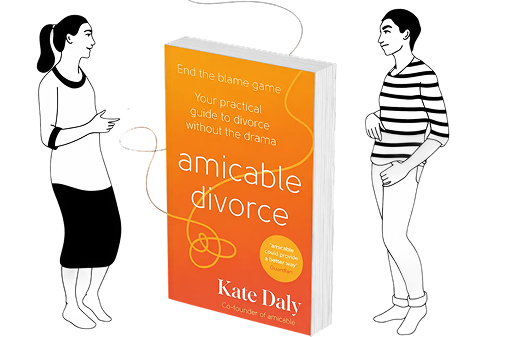
Comments (0)