.webp)
Who pays the mortgage when you separate?


When you separate, both of you remain responsible for any joint mortgage until a new legal agreement is in place or the property is sold. That means if one of you stops paying, the other is still fully responsible for the whole payment, and missed payments can affect both of your credit scores. amicable helps couples work out a fair approach to the mortgage as part of a broader financial settlement, together, without taking sides.
Separation brings up a lot of practical questions quickly, and the mortgage is usually one of the first. Who pays? What if you can't afford it alone? What if one of you moves out? This blog explains how a joint mortgage works during separation, what your options are, and how to start having those conversations without it becoming a battle.
What happens to a joint mortgage when you separate?
Your mortgage doesn't change the moment you separate. If both of your names are on it, both of you stay responsible for every payment until you've formally sorted out what happens to the property.
This is the part that catches a lot of people off guard. Responsibility for a joint mortgage is not split 50/50 in the eyes of the lender,you're each responsible for the whole amount. Lenders call this joint and several liability. This means, regardless of who hasn’t paid, both of you are responsible for the debt.
Other things to point out:
- Your lender doesn't recognise separation as a reason to change the mortgage terms
- Moving out doesn't remove your name or your responsibility
- If one of you stops paying, the other is still liable for the full amount
- Missed payments can affect both of your credit files, regardless of who stopped paying
42% of splitting couples own property together (Source: amicable, Splitting: The Bill, Opinium survey of 2,000 UK adults, fieldwork 26 March to 10 April 2026)
Can you stop paying the mortgage when you separate?
Technically you can stop paying, but the consequences can be serious. Missed payments can build up quickly and affect both your credit scores and your ability to get a mortgage in the future.
Even if your ex-partner has moved out or agreed verbally to cover payments, that agreement isn't binding with the lender. Your name on the mortgage means you're still on the hook.
Before you make any decision about payments, it's worth knowing:
- A verbal agreement between the two of you doesn't change what you owe the lender
- If you're struggling financially, your lender has an obligation to treat you fairly under FCA rules, you can contact them directly to discuss your options
- Any formal agreement about who pays what during separation should be written down, ideally as part of a separation agreement
- For married couples, formal arrangements or a separation agreement should be drafted into a consent order, to be submitted to court for approval, once the conditional order has been pronounced.
Who pays the mortgage if one person moves out?
This is one of the most common situations, and one of the most misunderstood. Moving out doesn't change your legal responsibility for the mortgage. Both of you remain liable.
In practice, many couples agree that the person staying in the home continues to make the mortgage payments while the finances are being sorted out. That can be a reasonable short-term solution, but it needs to be documented and reviewed as part of the wider financial settlement.
Things to think through together:
- Can the person staying in the home realistically cover the full mortgage payment?
- How will the equity in the property be accounted for in the final financial settlement?
- Is there a clear timeframe for resolving the longer-term plan for the property?
- The impact of another property to pay for on your joint finances, in the period after separation but before your financial settlement is finalised
What are your main options for the property?
This is where most of the longer-term decision-making sits. You have several options, and the right one depends on your finances, whether you share children and what you both want for the future.
Your main options at a glance
Option one: One of you buys the other out
What it involves: One person takes over the mortgage in their sole name What to think about: Needs lender approval and a remortgage. The buying-out partner needs to qualify on their own income.
Option two: Sell and split the proceeds
What it involves: You sell the property and divide what's left after paying off the mortgage What to think about: Gives you both a clean break. Costs involved include estate agent fees and, usually, stamp duty on a new purchase, early redemption penalties.
Option three: One of you stays with no formal buyout
What it involves: One person remains in the home without transferring the mortgage What to think about: Leaves the other person tied to the mortgage and can affect their ability to borrow. Not recommended long-term without a legal agreement
Option four: Defer the sale (mesher order or martin order or transfer with a charge back)
What it involves: The sale is postponed, often until children reach a certain age or a certain event. What to think about: Keeps the children in the family home. Requires a court order and careful legal planning
Option five: Continue to co-own
What it involves: You both remain on the mortgage and agree to sell or transfer at a later point What to think about: Can work short-term but needs a clear agreement about when and how it ends
Just over two in five couples (42%) own a property together. Of those, 33% have one partner stay and buy the other out, 27% sell and split the proceeds, and 26% have one partner stay with no formal buyout. Only 2% choose nesting, where the children stay in the home and parents rotate in and out, though that rises to 6% in London. (Source: amicable, Splitting: The Bill, Opinium survey of 2,000 UK adults, fieldwork March to April 2026.)
It takes 6.7 months on average to resolve family home arrangements after a split, so starting these conversations early gives you more time to find a solution that works.
How to talk about the mortgage when you separate
Communication is one of the things that makes the biggest difference to how smoothly this process goes, and also one of the hardest things to get right when you're both under pressure.
A few approaches that tend to help:
Choose the right time and place. Conversations about money and property need space and calm. Avoid bringing them up in the middle of an argument or through text messages where tone is easy to misread.
Separate the practical from the emotional. You might feel very differently about the family home. One of you might want to keep the home for the children, but not be able to afford it on their own, whereas the other might want a clean break. If one or both of you feel stuck in the emotional journey, get support from a therapist, counsellor or coach. It helps to acknowledge those feelings separately from the financial and legal decisions you need to make together.
Write things down as you go. Any agreement you reach, even a temporary one, is clearer when it's in writing. It also helps recollection and future discussions if memories differ later.
Get support if the conversation isn't moving. If you're finding it hard to talk about the property without things becoming difficult, a Divorce Specialist can help you structure the conversation, or you can look at amicable's Negotiation Services, which support you both to reach a financial agreement with expert help throughout.
Be honest about what you can afford. It helps to have a shared, realistic picture of your financial situation, including what each of you earns and spends before you start talking about what's possible. Sharing your financial information openly is a legal requirement as part of any formal financial settlement anyway, so starting from a place of honesty makes the whole process smoother.
What happens to the mortgage as part of a financial settlement?
If you're divorcing, any agreement about the property needs to be made into a consent order to become legally binding. Without one, either of you can make a financial claim against the other years down the line, even after the divorce is finalised.
A consent order sets out exactly what's agreed: who gets the property, how any sale proceeds are divided, or when and how a transfer will happen. Your lender also needs to agree to any changes to the mortgage itself, so the legal agreement and the lender's approval need to work in step with each other.
If you're separating but not divorcing, a separation agreement can set out your arrangements, though it has a different legal status to a consent order.
For couples who are unmarried and co-own a property, the starting point is usually the legal ownership of the property, which depends on how it was registered and whether you have a declaration of trust. This is an area where getting advice from a Divorce Specialist or independent legal advice is worth doing early.
Pensions, savings and everything else
The mortgage is usually the biggest financial question, but it's rarely the only one. Pensions are another area where decisions can have a long-term impact, and they're often overlooked. amicable's Splitting the bill report found that only 12% of adults agreed the division of a pension pot during their split, and 22% didn't know pensions could be shared at all (Source: amicable, Splitting: The Bill, Opinium survey of 2,000 UK adults, fieldwork March to April 2026).
Getting a full picture of all your finances together, including pensions, savings and other assets, before you focus on the property can help you see the whole picture and make decisions you're both comfortable with.
FAQs
Who is responsible for the mortgage when we separate?
Both of you remain responsible for a joint mortgage until it is formally transferred or the property is sold. Separation doesn't change your mortgage contract with the lender, so if one of you stops paying, the other is still responsible for the full amount.
Can I stop paying the mortgage if I've moved out?
Your name stays on the mortgage whether you live in the property or not. Stopping payments can affect both your credit files and, if payments are missed for long enough, may put the property at risk. Talk to your lender and get a plan in place as soon as you can.
What happens to a joint mortgage after separation?
A joint mortgage stays in both your names until you take a formal step to change it. Your options include one of you buying the other out and remortgaging into a single name, selling the property, or agreeing a deferred sale. Each option needs the lender's agreement, and any financial arrangement should be made into a legally binding agreement, such as a consent order if you're divorcing.
Does my lender need to know we've separated?
You're not legally required to tell your lender you've separated, but it's often worth doing. Some lenders have specialist teams who can talk through your options, and if you're struggling to keep up with payments, contacting them early gives you more room to find a solution.
What if we can't agree on what to do with the family home?
If you're finding it hard to agree, you don't have to work it out alone. amicable's Guided Negotiation Service supports both of you to reach a financial agreement with expert help, without going to court. A Divorce Specialist can also talk through your options in a free 15-minute consultation.
How long does it take to sort out the family home after separation?
On average it takes 6.7 months to resolve family home arrangements after a split, according to amicable's Splitting: The Bill report. Starting the conversation early and getting support to reach a clear agreement can help keep things moving.


Start your amicable divorce journey
Speak to an amicable Divorce Specialist to understand your options and next steps for untying the knot, amicably.
Your guide to a kinder divorce
What if divorce didn’t have to be a battle?
In amicable divorce, Kate Daly offers compassionate, practical guidance to help you separate in a kinder, better way. Whether you’re just beginning, working through the practicalities or adjusting to co-parenting, this book meets you exactly where you are - and helps you move forward with confidence.
Order on Amazon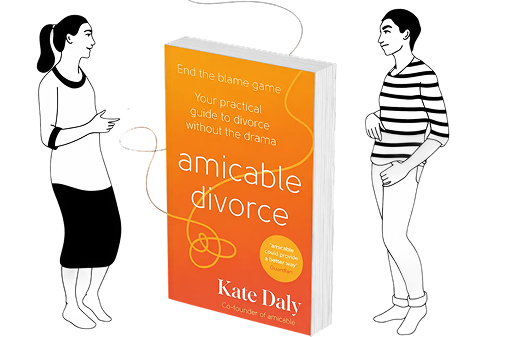
Comments (0)