
Understanding Islamic divorce in England and Wales: The essential guide


If you’re going through an Islamic divorce in England and Wales, you may need to complete both a religious divorce and a civil divorce. A Nikah on its own is not usually legally recognised under English law, which can affect your financial rights. Understanding how the two processes work together can help you protect yourself and move forward with clarity.
Separation is never simple. When faith and law overlap, it can feel even more complicated. At amicable, we often speak to Muslim women and men who are unsure where they stand legally after a Nikah. This guide explains what Islamic divorce involves, how civil law applies in England and Wales, and what practical steps you can take to separate amicably.
What does an Islamic divorce involve?
An Islamic divorce ends your marriage in the eyes of Allah and within the community. A civil divorce is about your legal status, finances and arrangements for children under the law in England and Wales.
The main types of Islamic divorce types are:
- Talaq - initiated by the husband
- Khula - initiated by the wife, usually with her husband’s consent
- Faskh-e-Nikah - dissolution granted by a religious authority without the husband’s consent
Courts in England and Wales can’t grant you an Islamic divorce. But if you're legally married under civil law, they can take your Mahr (dowry) into account when deciding how to divide your finances.
Is a Nikah legally recognised in England and Wales?
A Nikah is the Islamic marriage contract witnessed by family members and an Imam, with the agreement of Mahr (dowry) between the spouses. It holds deep spiritual importance for Muslim couples and is considered the foundation of a halal relationship under Sharia Law.
However, in England and Wales, a Nikah is only legally recognised if:
-
It’s combined with a civil ceremony at a register office or an approved venue, or
-
It took place overseas in a country where the Nikah has full civil status and is legally valid and recognised under English law
-
If you only had a Nikah in England and Wales - for example, at a mosque or at home without a civil registrar present - you are not legally married under English law. This means you are usually treated as cohabiting partners rather than spouses.
How do your rights during divorce differ without legal marriage?
If you’re legally married, family courts can divide money and property and approve financial agreements. If you only had a Nikah and no civil marriage, you generally do not have access to the same rights or processes. This can feel worrying, particularly for women who may have stepped back from work or relied financially on their spouse. Getting early legal clarity is important.
| If you're legally married | If you only have a Nikah |
|---|---|
| Access to spousal maintenance | No automatic right to spousal maintenance |
| Pension sharing on divorce | No pension sharing rights |
| Capital redistribution under Matrimonial Causes Act 1973 (financial settlement dividing the matrimonial assets) | No automatic share of partner’s money and property |
| Court protection for your financial settlement | Must rely on trust or property law for any claims |
Practical tips if you only have a Nikah
If you have only had a religious ceremony without legal recognition, consider:
-
Seeking legal advice on property, children and any joint assets
-
Exploring a cohabitation agreement to clarify financial arrangements
-
If still together, arranging a civil ceremony to protect both of you in future
How do the courts treat Mahr?
Mahr is a financial provision agreed within the Nikah contract. If you’re legally married under civil law, courts in England and Wales can consider the Islamic Mahr (dowry) as part of the overall financial picture. In some cases, it may be treated as:
- A contractual obligation that should be honoured
- A relevant factor when deciding lump sums, marital assets or property adjustment orders
- Unpaid Mahr in a legally recognised marriage can sometimes be addressed within the family court as part of a broader financial settlement, though outcomes vary case by case.
In this episode of The Divorce Podcast, Kate Daly and Dr. Leyla Hussein sit down to talk about cultural and faith-based aspects of divorce. Dr Hussein shares her personal experience of going through an Islamic divorce and the social challenges faced when a marriage ends within a religious context. The episode offers a powerful perspective that may resonate with many Muslim women and men who have had to balance faith and legal systems during separation.
What’s the difference between civil and Islamic divorce?
An Islamic divorce certificate is important for religious status, potential remarriage in a mosque and community recognition. However, it has no effect on civil marital status in England and Wales.
If you are legally married under civil law, you must also obtain a civil divorce to end the marriage legally in England and Wales. Since 6th April 2022, England and Wales has operated a no-fault divorce system. This means you do not need to prove that someone did something wrong, you simply confirm that the marriage has irretrievably broken down. This applies to all legally married couples, including Muslims.
The civil divorce process - step by step
If you are legally married, the civil process usually follows these steps and the process is a set timeline:
-
Application : Submit a divorce application (jointly or individually)
-
20-week reflection period : The mandatory waiting period after application
-
Conditional order : Apply for a conditional order (formerly Decree Nisi)
-
Financial settlement : Negotiate your finances and draft a consent order
-
Final order : Apply for a final order (formerly Decree Absolute) to legally end the marriage
If you want your financial agreement to be legally binding, you’ll need a consent order approved by a court. You can read more in our guide to no-fault divorce in England and Wales and our explanation of what a consent order is and why it matters.
How to get an Islamic divorce in England and Wales
Most Islamic divorces in England and Wales are handled through a Sharia council.
The process typically involves:
-
Choose the appropriate route: Decide whether Talaq, Khula or Faskh applies to your situation
-
Gather documents: Nikah certificate, proof of identity, address, evidence of marriage breakdown and any previous civil divorce paperwork
-
Apply to a Sharia council: Submit application forms and pay the required fee
-
Notification: The council notifies the other spouse and allows a response period
-
Meetings or reconciliation attempts: Both people may be invited to attend
-
Decision: The council issues its ruling
-
Certificate: An Islamic divorce certificate is issued as a formal document
Fees vary between councils and are usually a few hundred pounds, depending on the type of application.
Many councils encourage reconciliation before issuing a final certificate. This may involve:
-
Appointing arbitrators - one from each family - to explore whether problems can be resolved
-
Counselling or mediation facilitated by the council or an imam
-
Both spouses attending meetings, submitting written statements and engaging in structured discussions
What are the different types of Islamic divorce?
Talaq
When a husband initiates divorce, he pronounces Talaq - usually once, not the 'triple Talaq' practice now widely discouraged and banned in several countries. The Iddah (waiting period) follows, typically lasting three menstrual cycles or approximately three months. During this time:
- The wife retains her full rights to the Mahr
- The husband must continue providing financial support
- Reconciliation is possible without a new marriage contract if both parties agree
Khula
When a wife wishes to end the marriage, she may seek divorce through Khula. This typically involves returning some or all of the Mahr to be released from the marriage. In the UK, Khula is often handled by a muslim law Sharia council and requires the husband’s consent. If the husband refuses, the process can become more complex.
Faskh-e-Nikah/Tafreeq
Where the wife can demonstrate grounds such as domestic abuse or abandonment, a Sharia council or religious panel may dissolve the marriage through Faskh-e-Nikah. This route is available even without the husband’s agreement, providing an important protection for muslim women in difficult situations.
If you are experiencing abuse, your safety comes first. Support is available through organisations such as Refuge, Women’s Aid and the Men’s Advice Line.
How should you approach arrangements for children?
In England and Wales, decisions about children after separation are governed by the Children Act 1989, with the child’s welfare as the court’s primary consideration. This aligns well with Islamic principles, which place strong emphasis on the wellbeing of children, cooperation between parents and maintaining relationships with both parents.
When planning arrangements, consider:
- Where the children will live
- Time spent with each parent
- School holidays and travel arrangements
- Special days such as Ramadan and Eid
- Religious education and practices
If you need structured support, our Separating with Children Service can help you and your ex-partner create practical, child-focused arrangements without unnecessary conflict.
How amicable can help
If you are legally married and need to complete the civil divorce process, we offer:
- Fixed-fee divorce and separation services
- Support reaching financial agreements
- Help drafting and submitting consent orders
- Guidance through every stage of the timeline
Our approach focuses on cooperative solutions. We help you reach fair agreements without unnecessary adversarial court battles.
You can book a free 15-minute consultation with one of our Divorce Specialists to understand your position and next steps.


Support for co-habiting couples
Speak to an experienced Separation Specialist to understand your options. We help couples with all the legal, financial and family aspects of separation.
Book a free 15-minute consultationYour guide to a kinder divorce
What if divorce didn’t have to be a battle?
In amicable divorce, Kate Daly offers compassionate, practical guidance to help you separate in a kinder, better way. Whether you’re just beginning, working through the practicalities or adjusting to co-parenting, this book meets you exactly where you are - and helps you move forward with confidence.
Order on Amazon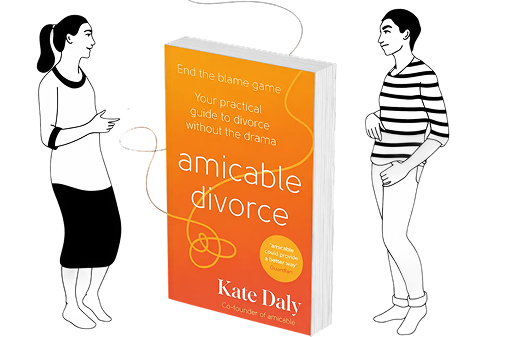
Comments (0)