
Tess Daly and Vernon Kay's amicable separation: what their split teaches us about modern divorce


After 22 years of marriage, Tess Daly and Vernon Kay have announced they're separating. In their joint statement, they were clear about two things – the decision was mutual, and their two daughters come first. They told the public they remain great friends.
It's the kind of announcement that would have been almost unthinkable a decade ago, but it's quietly becoming the new normal.
A quieter kind of celebrity split
The Tess Daly and Vernon Kay separation follows a string of high-profile couples choosing a calmer, more collaborative path – Jennifer Lopez and Ben Affleck, Sacha Baron Cohen and Isla Fisher among them. None of these splits have been turned into tabloid warfare. All of them have, in one way or another, signalled the same thing: we're ending things amicably.
For couples wondering whether their own split has to be a battle, just knowing that this is possible can make a huge difference.
Kate Daly, co-founder of amicable, puts it like this:
'Whenever a couple separates in the public eye, the way they choose to do it can transform what happens next. When children are involved, that choice matters even more. Parents who can work together through their split – even when it’s painful – give their children the best possible foundation to process it in a healthy way.’
Why are people choosing amicable separations?
We don't know the specific reasons behind any individual celebrity split, but we do know what the wider data tells us about why marriages end – and how people are choosing to end them.
People are living longer. Careers, identities and priorities shift. Couples who married in their twenties or thirties often find themselves in their fifties wanting different things from the next chapter. That doesn't make the marriage a failure, it just means that things have changed.
After no-fault divorce was introduced in 2022, couples in England and Wales no longer need to blame each other to get divorced. That single legal change has shifted the tone of separation enormously. You don't have to start with an accusation: you can start with a conversation.
The real cost of conflict – and who pays it
amicable's recent research report, 'Splitting: The Bill', surveyed 2,000 adults in the UK who'd been through a divorce, dissolution or separation in the last 10 years. The findings on children are stark:
A high-conflict split makes parents nearly three times more likely to say their divorce had a very negative impact on their child's mental wellbeing (19% vs 7%).
57% of parents going through an unamicable divorce said their child's relationship with their ex-partner was negatively affected – compared with 30% of amicable divorcees.
Nearly a third (32%) of UK splits involve significant conflict or are highly adversarial.
An unamicable split takes nearly four months longer to resolve – 15.4 months on average, compared with 11.6 months for amicable ones.
A study of more than 96,000 families published in the Journal of Affective Disorders in December 2025 reinforced what family therapists have said for years – children in unhappy, conflict-ridden marriages show higher rates of depression, anxiety and self-harm than children of divorced parents. It's the conflict in the home, not the separation itself, that causes the most damage.
Kate adds:
‘Every extra month a family spends locked in conflict is a month their children spend in the middle of it. That’s the part of the bill that doesn’t show up on any invoice – and it’s the one that matters most. When parents choose a collaborative route, they’re not just protecting their finances. They’re protecting their children’s wellbeing, their relationship as co-parents and the family they have spent their life working for.’
What ‘amicable’ actually means (and what it doesn't)
There's a misconception that an amicable separation means pretending everything is fine, staying best friends forever or never feeling angry. It doesn't.
An amicable separation means:
- Making practical, grown-up decisions together
- Getting the right support so the process doesn't escalate
- Keeping the family unit functional even when the couple's relationship breaks down
- Putting children's wellbeing at the centre of every decision
- Avoiding long, drawn-out solicitor battles wherever possible
The shift away from solicitors
How couples in England and Wales separate has changed dramatically in just a decade. Ten years ago, more than half (52%) used a solicitor to handle their split. In the last 12 months, that figure has almost halved to 28%. Over half (52%) of those who separated in the last year handled the legal process themselves, with others choosing mediation, online divorce services, or specialist couples' legal and negotiation services like amicable.
And the outcomes are shifting too. In the same period there have been 7% more amicable splits, 10% fewer highly contested separations, and the average separation is 2.5 months shorter.
‘For decades, the default for anyone going through a divorce was to walk into a solicitor’s office and brace for a fight. That’s just not how most people want to separate any more – and the data proves it. Couples are realising they don’t have to hand their lives over to two opposing legal teams to end a relationship. They can stay in the driving seat, work together and reach decisions that actually fit their family. When high-profile couples model that, it disrupts the antiquated media narrative that divorce equals conflict – it gives quiet permission to everyone else to do the same.’
How to separate amicably: a practical starting point
If you're recognising your own situation in any of this, here's what an amicable approach actually looks like in practice.
1. Have the conversation before you make any decisions
Even if you've already decided to separate, agreeing the ‘how’ together – the timing, what you tell the children, what you tell the wider family – sets the tone for everything that follows.
2. Use one service, together, instead of two opposing solicitors
The traditional divorce process puts you on opposite sides of the table by design. A service that works with both of you keeps the conversation collaborative and is almost always quicker and more affordable.
3. Lead with the children
Decisions about where they'll live, how time will be shared and how you'll co-parent should be made by the two people who know them best: you.
4. Plan the practical stuff early
Finances, the home, pensions, debts. The sooner you map it out together, the less room there is for it to become an argument later.
5. Get emotional support separately from legal support
A Divorce coach or counsellor can help you process the grief without it leaking into the negotiations. Mixing the two is often what makes things escalate.
6. Write things down
A consent order makes what you agree legally binding. Verbal agreements feel kind in the moment but can unravel years later, so it’s better to protect yourself with something solid.
How amicable can help with your divorce
amicable has helped thousands of couples in England and Wales separate without the conflict, the cost and the adversarial process of traditional divorce. 95% of our customers reach an agreement without going to court.
We work with couples – not against one of them. Our Divorce Specialists support you through the legal process, financial negotiations and arrangements for children, all on fixed fees, all delivered online and all designed to keep you in the driving seat of your own separation.
Whether you're at the very start of the conversation or somewhere in the middle of it, we can help.
Book a free 15-minute advice consultation with one of our Divorce Specialists.
.webp)

Start your amicable divorce journey
Speak to an amicable Divorce Specialist to understand your options and next steps for untying the knot, amicably.
Your guide to a kinder divorce
What if divorce didn’t have to be a battle?
In amicable divorce, Kate Daly offers compassionate, practical guidance to help you separate in a kinder, better way. Whether you’re just beginning, working through the practicalities or adjusting to co-parenting, this book meets you exactly where you are - and helps you move forward with confidence.
Order on Amazon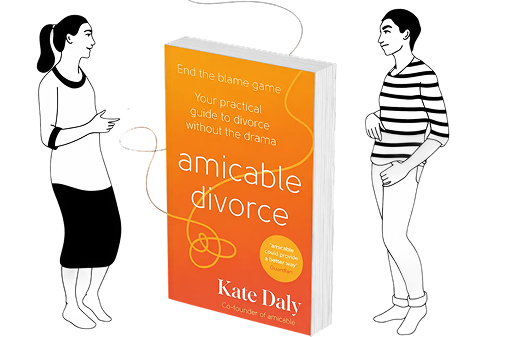
Comments (0)