
Splitting up when you're not married: what are your rights?


If you're separating from someone you live with but haven't married, you could feel uncertain about what you're entitled to. While unmarried couples have fewer automatic legal protections than married couples, there are still important rights and practical steps you can take to protect yourself.
In this article, we explore how an unmarried separation process differs from a legal divorce and how you can come to an outcome that feels fair for you both.
What's the legal difference between married and unmarried couples?
The key difference is that when you're married, family law automatically protects your rights to property, pensions and maintenance. When you're not married, those automatic protections don't exist, even if you've lived together for years.
Generally speaking, instead of relying on family law to divide your assets, you'll need to agree how to split your money and property, ideally with a written agreement.
There's no automatic entitlement to a share of your partner's pension, no automatic maintenance for ex-partners and no single court route to divide things fairly if you can't agree. While this can feel daunting, it also means you can both have more control over the outcome.
What rights do you actually have?
You may still have legal rights to claim a share of property or assets, but you'll need to prove your contribution or show there was an agreement between you. Our article, what are your legal rights when separating if you live together but you're not married? is a useful resource to help you.
You might have claims in equity or under trust law if you've contributed to a property but it's in your partner's name. However, these claims are expensive and can be uncertain to pursue through court. It's generally better to come to an agreement if you can.
If you have children together, parental responsibility is automatic if you're both on the birth certificate, but you'll need to agree on child arrangements and maintenance.
Where a child spends more time living with one parent than the other, child maintenance can be arranged through the Child Maintenance Service (CMS) if helpful. In some circumstances, the court can also make orders for child maintenance and housing.
Protecting yourself when you split up
The simplest route is to agree on how you'll divide your money, property and responsibilities, and to put what's decided in writing. A separation agreement sets out who gets what, for example,
- How any property will be dealt with
- How any assets are split
- Responsibilities for debts
- Maintenance paid between you
Whilst a separation agreement isn't legally binding in the same way a court order is, it's a clear record you can both refer to. It is a contract between you both and can be persuasive to the family court. It also protects you both if circumstances change later and either of you needs to refer back to what was decided.
If you're worried you might not have been properly protected in the past regarding property or assets, that's something to discuss with an amicable Divorce Specialist. If you do own property together or have significant shared assets, it can be valuable to seek expert advice on what you're entitled to.
Here are some practical steps to get you started.
- Gather information about your shared finances, property and any debts
- Have an honest conversation about how you both want to split things
- Get advice from an amicable Divorce Specialist on what you're both entitled to
- If you have children, agree on child arrangements and maintenance
- Document your decisions in a separation agreement
This is different from a divorce, but it's just as important to do it properly. Essential guide: splitting your money and property and making financial arrangements covers the practical details you'll need to think through.
Helpful tools and support
Articles
What are your legal rights when separating if you live together but you're not married? What is a separation agreement and when do you need one? Essential guide: splitting your money and property and making financial arrangements What to expect on your first call with an amicable Divorce Specialist
Support
amicable space community forum - a supportive space to ask questions, share experiences and learn from others Separating with Children Service - sessions with a Co-parenting Specialist to help create calmer conversations and practical planning As an amicable space member, you can also book a free 30-minute consultation with an amicable Divorce Specialist.

Your guide to a kinder divorce
What if divorce didn’t have to be a battle?
In amicable divorce, Kate Daly offers compassionate, practical guidance to help you separate in a kinder, better way. Whether you’re just beginning, working through the practicalities or adjusting to co-parenting, this book meets you exactly where you are - and helps you move forward with confidence.
Order on Amazon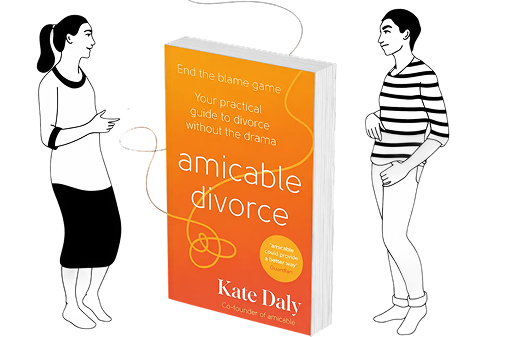
Comments (0)