
Understanding the divorce process
In England and Wales, divorce is made up of two or three key parts, depending on your situation:
.avif)
The legal steps
Formally ending the marriage

Financial arrangements
Deciding how money, property and pensions are divided

Child arrangements
Agreeing how children will be cared for (if you have children)
While the legal divorce itself is largely administrative, most conflict and cost arise around finances and children. Understanding this early helps you focus your energy where it matters most.
Six expert tips from amicable
Don’t rush the process
People rarely enter separation in the same emotional place. The partner who initiates the divorce has usually had more time to process the decision. The other may be shocked, grieving or trying to catch up.
If you push too soon or move too fast, the process often slows down. Book a free 15-minute advice consultation with one of amicable’s Divorce Specialists to learn more about the process, your options and how to keep things on track sensitively. Their advice will reduce conflict and help you both move forward together.
Read more less

Negotiate from a position of knowledge, not emotion
Divorce negotiations are much calmer when both people understand:
- How the legal process works
- What the law considers fair
- What a court would prioritise if asked to decide
Without this shared understanding, discussions can easily become personal or unrealistic. The key is to avoid emotional decision-making, especially when it comes to finances.
Read more less
Make a plan - together
One major reason divorces become stressful or expensive is a lack of planning. If you’ve never divorced before (and most people haven’t), it’s difficult to know what the timeline looks like.
Without clear agreements or a plan in place:
- one partner may feel frustrated that the pace is too slow
- the other may feel pressured or left behind
Creating a shared roadmap keeps both of you aligned, accountable and allows everyone the time to do appropriate research, ask questions or seek help if they need to.
Get your personalised divorce timelineRead more less
Know what’s in the pot
If you want to separate amicably, it’s important to make sure that splitting your finances is as smooth as possible. Before you agree on a financial settlement, you should:
- List everything you own
- Agree on its value
- Disclose all debts and financial commitments
Full financial disclosure is a legal requirement. If you’re not sure where to start, book a free 15-minute advice consultation with one of our Divorce Specialists.
Many couples also forget pensions - even though they may be among the largest assets. Make sure you request your CETV (Cash Equivalent Transfer Value) early, as this can sometimes take several weeks.
%201.avif)
Read more less
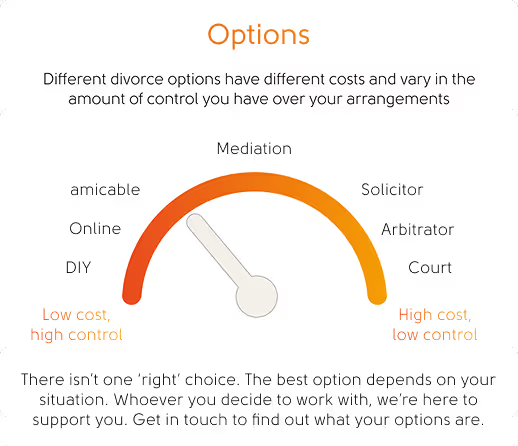
Don’t go straight to a solicitor
There are many ways to divorce amicably – and different processes suit different people and are unique to each situation. We believe most people can and should try to work together to separate in a better, kinder way.
Jumping straight to separate solicitors when you divorce can:
- increase costs immediately (even consultations are often billable)
- create a ‘me vs them’ mindset
- slow the process down
- reduce focus on the bigger picture
Learning how to communicate with your ex can go a long way and open up other opportunities for less combative routes to your separation.
Solicitors are useful in situations involving domestic abuse or where there are concerns about children’s safety. If you’re unable to agree, reach agreement, a court process may become necessary – but then further legal actions may need to be taken to implement the decision. This can add to stress, cost and delays - for everyone.
For more information on this, read five ways of getting a divorce without a lawyer.
Read more less
Divorce is about the future, not the past
One of the biggest factors in achieving an amicable divorce is a mindset shift: from working out things as a couple, to thinking about what your life will look like outside of the relationship.
You don't need to agree on your past – most couples never do. What matters now is the type of relationship you want going forward, whether that's as co-parents, or simply as two people moving on separately.
You don't need to agree on your past – most couples never do. What matters now is the type of relationship you want going forward, whether that's as co-parents, or simply as two people moving on separately.
amicable's co-parenting support helps separated parents build a positive relationship apart and provide stability for their family. Explore our Separating with Children Service and co-parenting app to see how we can help.
If you don't have children together, this same shift still counts. Choosing to stay on good terms, whether for mutual friends, family occasions, or simply your own peace of mind, can make the practical side of separating simpler and kinder for you both.
Read more less
What the court looks at when dividing finances
Before you start negotiating, it helps to understand what the court considers fair - because this is the framework your agreement will be judged against.
Divorce doesn't end your financial relationship
Divorce alone doesn't make your financial arrangements legally binding. You'll need a consent order to do that - and usually a clean break clause to prevent future financial claims. Without one, claims can remain open for years.
50/50 is a starting point, not a rule
There's no fixed formula for dividing money and property. The court's primary concern is that both people's needs - and any children's needs - are met. Factors it will consider include:
- Housing: both people should have suitable accommodation
- Earning potential and contributions: financial and non-financial contributions (including childcare and running the home) are treated equally
- Age and health: long-term ill health or proximity to retirement affects earning capacity and housing needs
- Length of marriage: shorter marriages with no dependents may justify a departure from equal division
- Pensions: often one of the largest assets - request your CETV early, as it can take several weeks to arrive
Children are the priority
If you have dependent children, their needs come first in any financial agreement. You don't need to go to court to make arrangements for them, but any financial settlement must show their needs have been met.
If you’re looking for support deciding arrangements for your children, explore our Separating with Children Service. If you’ve already made arrangements, you can use our co-parenting app to keep things on track.
Summary
When you understand the process and prepare, decisions become clearer and negotiations become calmer. You stay in control of the outcome and reduce stress, time and cost - for yourself, your ex-partner and your children.
We hope these tips help you approach your divorce or separation with confidence. For more information please contact us.
FAQs: How to divorce in England and Wales
Can we get divorced without going to court?
Yes. Most couples never attend court in person. The entire legal process can be done online and your financial arrangements can be made legally binding through a consent order without a court hearing. If you are unable to agree, you may need to attend a court hearing for a judge to decide on an outcome for your divorce, particularly if your disagreement is centred around children.
How long does a divorce take?
A no-fault divorce takes a minimum of six to eight months because of built-in waiting periods. If finances or childcare arrangements take longer to agree, the process may take longer.
Do we need a consent order?
A consent order legally finalises your financial settlement and creates a clean break - so neither of you are financially tied to each other. Without one, your financial claims against each other remain open, even years later.
What if we can’t agree on money or childcare?
You can use amicable’s negotiation services to help reach agreements, or book a joint session with a Co-parenting Specialist. Court should be a last resort due to time, cost and stress.
Is it possible to divorce totally amicably?
Yes. With the right support, clear communication and realistic expectations, most couples can separate in a calm and constructive way, even after difficult moments. Not many couples come to us in total agreement and our negotiation services are 95% successful.