
Managing guilt during divorce: why it's normal and how to move through it


If you're going through a divorce and feeling guilty, you're not alone.
Guilt is one of the most common emotions people experience during separation, yet it's one we talk about least. We discuss the other common emotions that come up during divorce often: anger, sadness and fear about the future. But guilt is often harder to talk about.
Maybe you feel guilty for ending the marriage. Maybe you feel guilty for not ending it sooner. Maybe you feel guilty about the impact on your children or your ex.
Let's talk about why guilt happens during divorce, why it's completely normal, and most importantly, how to move through it in a healthy way.
Why guilt is so common in divorce
Divorce affects other people
Your decision to divorce doesn't just affect you. It affects your children, your wider family and your friends. And while that can feel like a heavy responsibility, it's worth remembering that the impact isn't always negative.
Children whose parents separate well often thrive. Wider family can find a new normal. Friends adapt. The version of events you see in films and TV, where divorce leaves a trail of damage, isn't the whole picture.
But knowing your decision affects the people you love can still create guilt, even when you know it's the right choice.
You're going against expectations
Many of us grew up believing that marriage should last forever. Divorce might feel like failure.
Society still carries stigma about divorce, even though it's incredibly common. That stigma gets internalised as guilt.
You're focusing on what you could have done differently
Regardless of why the relationship broke down, whether someone had an affair, or you simply grew apart, it's easy to get stuck on what you might have done differently. If you'd tried harder, been more patient, or gone to counseling sooner.
This kind of thinking creates real guilt, even when you know you did everything you could.
Different types of guilt
Guilt for wanting the divorce
If you're the one who decided to end the marriage, you might feel guilty for feeling as though you have:
- Hurt your spouse
- Broken up the family
- Prioritised your own happiness
Guilt even though you didn't want the divorce
Interestingly, even people who didn't want the divorce often feel guilty. You might feel guilty about:
- Your part in the relationship
- Not seeing the problems sooner
- Contributing to the problems, even if you didn't cause them
- Feeling relieved on some level that it's ending
Guilt about your children
This is perhaps the heaviest guilt. You might feel guilty for feeling as though you have:
- Broken up their family home
- Made them live between two houses
- Exposed them to conflict
- Not being able to protect them from pain
Guilt about moving on
As time passes and you start rebuilding your life, new guilt can emerge:
- Dating someone new
- Enjoying your independence
- Not missing your ex enough
- Spending money on yourself
When guilt is useful and when it's not
Not all guilt is bad. Sometimes guilt serves a purpose.
Healthy guilt tells you when you've genuinely done something wrong that needs addressing. If you've been unkind to your ex during the separation, guilt can prompt you to apologise and behave differently. That's useful.
Unhealthy guilt punishes you for things that aren't actually wrong, or for things outside your control. Feeling guilty for wanting a divorce when you were deeply unhappy doesn’t help anyone.
The question to ask: is this guilt telling me to change my behaviour, or is it just making me suffer?
If you want to change, make amends where possible. If it's just making you suffer, it's worth working on letting it go.
How guilt can affect you
It keeps you stuck
Guilt can be paralysing. You might delay decisions because you feel too guilty to move forward. You might stay in an unhealthy dynamic with your ex because guilt makes you feel you owe them something.
It damages your wellbeing
Constant guilt is exhausting. It affects your sleep, your appetite, your ability to concentrate. It can lead to anxiety and depression.
It affects your parenting
Guilt can make you overcompensate with your children – giving them everything they want, not setting boundaries, trying to be the 'fun parent' to make up for the divorce. Of course, this doesn't actually help them, and can make things more difficult in the long run.
It prevents you moving forward
You can't build a new life while you're consumed with guilt about the old one. Guilt keeps you looking backwards when you need to look forwards.
Moving through guilt
Acknowledge it
Don't try to push guilt away or pretend it's not there.
Just admitting to yourself: I'm feeling guilty about this divorce’ can make a difference to how you feel.
Challenge the thoughts
When guilt arises, look at the thoughts behind it.
'I'm a terrible person for divorcing.' Is that actually true? Or are you someone who made a difficult decision in a difficult situation?
'I've ruined my children's lives.' Is that true? Or are your children adjusting, with support from both parents, to a new family structure that's ultimately healthier than staying in an unhappy marriage?
Often, guilt is based on exaggerated or distorted thinking. Challenge those thoughts with reality.
Separate guilt from responsibility
You can take responsibility for your part in the marriage breakdown without carrying guilt for the entire divorce.
Maybe you weren't the perfect spouse. Maybe you made mistakes. That’s normal, and you shouldn’t feel guilty.
Taking responsibility means acknowledging your role, learning from it, and doing better going forward, without guilt.
Forgive yourself
This is hard but essential. You did the best you could with the knowledge, resources, and emotional capacity you had at the time.
Maybe you wouldn't make the same choices now. Maybe you can see mistakes clearly in hindsight. But you can't judge past actions by current knowledge.
Forgive yourself for being human. Forgive yourself for not being able to make an impossible situation work.
Focus on what you can control
You can't control the fact that divorce is painful. You can control how you handle it.
You can be kind to your ex. You can prioritise your children's wellbeing. You can be honest and fair in negotiations. You can get therapy to process your emotions.
Channel your guilt into positive action rather than self-punishment.
Remember that divorce is sad, not bad
Guilt often assumes that divorce is inherently bad. But divorce is often the healthiest choice.
Children raised in a high-conflict household struggle more than children whose parents separated amicably. Staying in a deeply unhappy marriage isn't noble – it's harmful to everyone involved.
Divorce is painful, but it can also be the beginning of happier, healthier lives for everyone.
Get support
Talk to a therapist. They can help you process guilt, challenge unhelpful thinking patterns, and develop healthier ways of viewing the situation.
Talk to friends who've been through divorce. They understand the guilt and can reassure you that you're not alone.
Join a support group for people going through divorce. Hearing others express the same guilt you feel can be incredibly validating.
Learn more about finding therapeutic support during divorce here.
Give it time
Guilt often lessens with time. As you and your children adjust to the new normal, as you see that life does go on and can even be better, the guilt eases.
When to seek help
If guilt is seriously affecting your ability to function – if you can't sleep, can't eat, can't make decisions, can't be present for your children – please seek professional help.
Speak to your GP. Consider therapy or counseling. Guilt that severe isn't something you should try to manage alone.
Guilt is a normal part of divorce. It shows you have a conscience, that you care about the people affected by your decisions.
But guilt shouldn't consume you. It shouldn't stop you from building a new life. It shouldn't prevent you from being the parent your children need, or from finding happiness again.
You made the best decision you could in difficult circumstances. You're doing your best to handle the divorce well. That's enough.
Be kind to yourself. You're going through something hard. You deserve compassion – including from yourself.
At amicable, we support people through the emotional side of divorce as well as the practical. If you're struggling with guilt or other difficult emotions during your separation, book your free 30 minute consultation with us.
Helpful tools and support
Guides
How to deal with the emotional impact of divorce
Essential guide: The emotional journey of divorce
Support
amicable space community forum - A supportive place to share experiences, ask questions and hear from specialists as well as others at a similar stage.

Your guide to a kinder divorce
What if divorce didn’t have to be a battle?
In amicable divorce, Kate Daly offers compassionate, practical guidance to help you separate in a kinder, better way. Whether you’re just beginning, working through the practicalities or adjusting to co-parenting, this book meets you exactly where you are - and helps you move forward with confidence.
Order on Amazon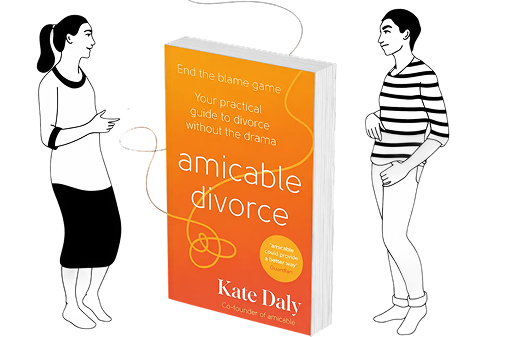
Comments (0)